
Novel Tools & Technology for HPAI Prevention
Stream 1 will reopen on August 4.
Stream 2 is now closed.
Please sign up for the newsletter to stay up to date on application details.
Technology to help prevent the spread of Highly Pathogenic Avian Influenza (HPAI) is needed in the western Fraser Valley and Metro Vancouver regions.
The Novel Tools and Technology for HPAI Prevention Pilot Program (NTT) is part of the Food Security Initiative and is funded by the Province of British Columbia. NTT is designed to evaluate the practicality and effectiveness of novel tools and technology for reducing the risk of Highly Pathogenic Avian Influenza (HPAI) on commercial poultry farms in high-risk areas of the Lower Mainland and reduce the overall impact of HPAI in the province.
Sign Up for the Newsletter
Program Overview
The Novel Tools and Technology for HPAI Prevention Pilot Program (NTT) is part of the Food Security Initiative and is funded by the Province of British Columbia. The program is delivered by IAF.
NTT is designed to evaluate the practicality and effectiveness of novel tools and technology for reducing the risk of Highly Pathogenic Avian Influenza (HPAI) on commercial poultry farms in high-risk areas of the Lower Mainland and reduce the overall impact of HPAI in the province.
There are two streams for the Novel Tools and Technology for HPAI Prevention Program:
Stream 1: Poultry Producer Novel Tools & Technology Implementation supports commercial poultry producers installing eligible novel tools and technologies on their commercial poultry farms in the Lower Mainland.
Stream 2: Research, Monitoring, and Evaluation supports suitable research partners who will generate, collect, test, and analyze detailed data about the effectiveness, practical use, and scalability of novel tools and technologies in reducing the overall impact of HPAI in the province.
Approach
NTT applications are accepted through the IAF Client Portal. Upon submission, applications are screened and reviewed by IAF in order of submission. This review involves:
- Ensuring application completeness
- Organization/Applicant eligibility check
- Project alignment and eligibility check
Applications will be assessed by Ministry of Agriculture and Food (Ministry) staff to ensure viability, reasonableness, and eligibility. The Ministry may be in direct contact with applicants (or any listed experts/contractors on the application) or request IAF follow up for clarification as required.
Submitting an application is not a guarantee of funding.
| Stream | Funding Maximum |
|---|---|
| Stream 1: Poultry Producer Novel Tools & Technology Implementation | 80% cost-share up to $30,000 per project |
| Stream 2: Research, Monitoring, and Evaluation Not currently accepting applications | $75,000 per project |
Retroactive Cost
Eligible expenses that have already been incurred can be included in your application and will be considered retroactively. This applies only to costs incurred from January 1, 2026, onwards.
Any costs incurred prior to a funding decision by IAF are entirely at risk of the applicant (should funding not be awarded), and application to the program does not guarantee funding.
IAF strongly recommends you sign up for the NTT Newsletter to stay up to date on the NTT program. This newsletter will provide program updates, clarifications, and reminders about upcoming application dates.
Stream 1: Poultry Producer Novel Tools & Technology Implementation
Eligibility
Eligible participants for Stream 1 are commercial poultry producers, including:
- Table egg layers
- Broiler breeders
- Duck, goose, turkey, and other poultry producers
- Conventional and specialty broiler farms
Please note: Prioritization may be given to premises that have been infected with HPAI multiples times since 2020, or premises that have not received previouis NTT funding.
To be eligible, applicants must:
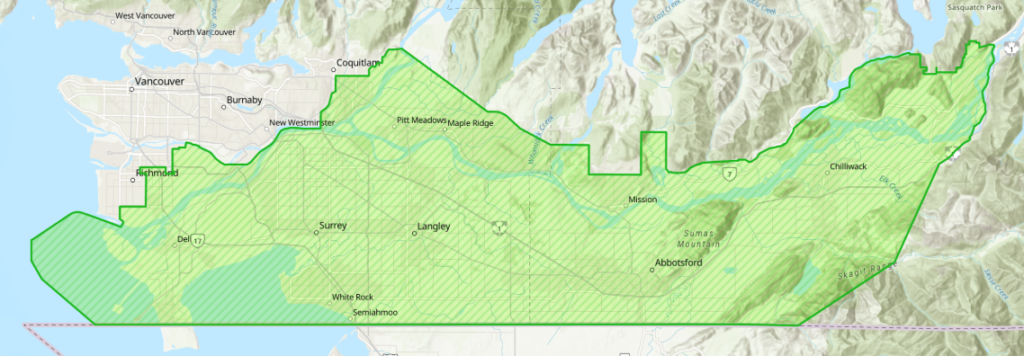
- Be based and operating within the eligible program region (see Figure 1) and file business or farm income taxes in BC.
- Agree to provide data requested by the Ministry, or designate, to allow for analysis to assess whether installing and operating various tools and/or technologies reduces the risk of flocks becoming infected with HPAI. Data may be collected from approved applicants from November 7, 2026, to June 30th, 2027, via 2 to 3 short online surveys.
- Agree to take part in NTT Stream 2 research projects as and where reasonably requested, to support the research and evaluation of the Working Group Recommended Novel Tools & Technologies and the Eligible Novel Tools & Technologies. Data may be collected by research teams approved for Stream 2 research from November 7, 2026, to June 30, 2027.
- Have an active 9-digit CRA business number.
- Constitute a legal entity.
- Be registered with the BC Premises Identification Program.
- Hold table egg, hatching egg, chicken or turkey quota under Canada’s supply management system or raise more than 300 ducks or geese in a calendar year commercially for the purpose of selling products and by-products.
Ineligible participants for Stream 1 include:
- Poultry producers who do not hold quota, or are raising poultry on a premise with fewer than 300 domestic birds (i.e., small-scale, hobby farms, or birds kept as pets or show birds)
Activities
Tools and technologies funded through this program must be installed to filter or treat the incoming or recirculated air in airspaces where poultry are kept. Either before or as part of the project, appropriate efforts should be made to ensure that the maximum amount of air being drawn into the airspace can be filtered or treated (e.g., sealing non-inlet air entry points and tightening barn pressure)
All tools and technologies funded by this program must be installed between January 1 and December 31, 2026. Participants must agree to operate the tools and technologies continuously until March 31, 2027, or until the BC Poultry industry biosecurity committee revokes biosecurity “Red” status in 2027, whichever comes first.
By participating in the NTT program, participants agree to provide data to the Ministry of Agriculture and Food (or designate) upon request, to allow for analysis to assess whether installing and operating various tools and technologies reduces the risk of flocks becoming infected with HPAI. Data may be collected by the Ministry from November 7, 2026, to April 30, 2027, via 2 to 3 online surveys and/or through Stream 2 approved researchers who may request premise access. The Ministry will work with researchers to ensure that any site access requests are reasonable and adhere to strict biosecurity standards.
Activities for Stream 1 can be completed by the producer or by subcontracting an allied agricultural industry company/professional with the required expertise and equipment.
Eligible Activities
Eligible costs under this program include:
- Mechanical Air Filtration – Installation of particulate filters (e.g., MERV 16 or above or HEPA).
- Ultraviolet (UV) Light Systems – Installation of UV-C systems to disinfect incoming or recirculated air.
- Positive Pressure Ventilation Systems – Installation of a positive pressure ventilation system to upgrade from sidewall inlets, creating a positive air pressure system within barn airspaces where poultry are kept. Should be combined with one other approved NTT activity.
Note: To see all details about eligible novel tools and technology, scroll down to the Eligible Novel Tools & Technology Guide.
Program Prioritization
If the requested program funding exceeds available funding, adjudication and funding may be prioritized for premises that have been infected with HPAI multiple times since 2020, or for premises that have not received previous NTT funding.
Applying to the Program
High demand is expected for NTT. We encourage you to submit a completed application(s) as soon as possible. Applying is not a guarantee of funding.
Notification of application closure will be provided in the NTT Newsletter and posted to this webpage.
Applications will be reviewed and adjudicated on a first-come, first-served basis until available funds are fully committed.
Applications will be assessed by Ministry of Agriculture and Food staff to ensure viability, reasonableness, and eligibility. The Ministry may be in direct contact with applicants (or any listed experts/contractors on the application) or request IAF follow up for clarification as required. Funding decisions for Stream 1 will be provided within 6 weeks of complete application submission
Important Program Dates
Applications Open
Submissions Accepted
Applications Close
Project Start
Project Completion
Accessing the IAF Client Portal
To apply to the program, you must first create an IAF Client Portal account and register your organization by navigating to the IAF Client Portal and selecting “Create an account now.”
If you have previously applied to an IAF-delivered program you can skip this step – you’re already registered!
Sign Up & Register
To apply to the program, you must first create an IAF Client Portal account and register your organization by navigating to the IAF Client Portal and selecting “Create an account now.”
If you have previously applied to an IAF-delivered program you can skip this step – you’re already registered!
Starting your NTT Application
If you’re reading this information prior to application submissions opening, you can start (i.e. draft, edit & view) your application. This takes the pressure off for first-come, first-served programs – allowing you to work on your application without the pressure of submission.
To find the application navigate to the ‘Opportunities‘ tab in the IAF Client Portal and select NTT.
Review and Adjudication
Prior to funding decisions being made, project applications are screened and reviewed by IAF. This review involves:
- Ensuring application completeness.
- Organization/Applicant eligibility check.
- Project alignment and eligibility check.
Applications will be assessed by a Ministry of Agriculture and Food staff member to ensure viability, reasonableness, and eligibility.
Applications for funding should be complete at the time of submission. If any required information is not submitted with the application, it will be returned to the applicant requesting missing information and can slow down funding decision timelines.
IAF will email applicants to Stream 1 with a funding decision within 6 weeks of submitting a completed application. All decisions are final. All applicants will receive a funding decision email from IAF via the IAF Client Portal. The status of an application can be found anytime in the IAF Client Portal.
NTT Prioritization
If the requested program funding exceeds available funding, adjudication and funding may be prioritized for premises that have been infected with HPAI multiple times since 2020, or for premises that have not received previous NTT funding.
Notifications & Obligations
Funding Notifications & Contracts
If the application is approved, IAF will inform the proponent by email with the details of the decision and any associated terms and conditions. Funding is application and project-specific; funding must be used for the approved activities and related expenses. Funds are non-transferable.
Approved projects may begin as soon as approved, with retroactive expenditures being considered up to January 1, 2026, for Stream 1. All Stream 1 projects must be completed by December 31, 2026.
If the application is not approved, the applicant will receive a funding decision email from IAF.
Arm’s Length Transactions
All businesses from which goods or services are purchased must be at Arm’s Length from the applicant, meaning not related to the applicant, not affiliated with the applicant, or controlled in any way by the applicant.
Reporting Requirements
Successful applicants must complete a project report prior to receiving funds from the program. This report must be filled out and submitted to IAF along with all invoices for the project to be considered for funding reimbursement. It is important the final report is submitted on time and with all required information. Expenses will be reimbursed based on the submitted receipts and the approved project budget. All reporting will be completed via the IAF Client Portal.
Changes to Contracted Projects
If you are not able to complete your project or require a change, please inform the IAF Team as soon as possible by emailing ntt@iafbc.ca.
Project Audit
Projects may be audited. Please retain all project documentation. The IAF Team or a representative will reach out if your project has been selected for audit.
Funding Acknowledgments
This program is funded by the Government of British Columbia through the Food Security Initiative. As such, acknowledgement of funding is required if or when public communication about a project and/or funding occurs. To ensure appropriate acknowledgement, all communications and marketing materials, including public announcements or social media posts, must be pre-approved by the IAF Communications Team. Details on correctly acknowledging funding can be found on the Project Resource Hub. Materials must be submitted via the IAF Client Portal.
Resources
FAQ
Eligible Novel Tools and Technology Guide
| Eligible Technology | Installation of particulate filters (e.g., HEPA, or MERV 16 or higher). |
| Cost | Variable – dependent on filter/ model |
| Considerations | – Selection of filter (MERV, HEPA) depends on the desired size of particles to filter – More efficient filters may be more costly – Filters may accumulate dust in barn environments |
- Filters with a MERV rating below 16 may be used as a pre-filter with more expensive HEPA filters and could also be useful when used in conjunction with other Eligible novel tools and technologies as a pre-filter.orem ipsum dolor sit amet, consectetur adipiscing elit. Ut elit tellus, luctus nec ullamcorper mattis, pulvinar dapibus leo.
- Mechanical air filtration is a well-established way to filter particulate matter and aerosols from air. There are many different types of air filters, and they are typically categorized based on their efficiency. For example, Minimum Efficiency Reporting Values (MERV) ratings are determined for filters based on the average filtration efficiency for different sizes of particles. A higher MERV rating means the filter can efficiently remove a greater range of particles at a higher efficiency.
- High-efficiency particulate air (HEPA) filters meet requirements beyond MERV filters, efficiently removing even smaller particles. The selection of an appropriate filter, therefore, depends primarily on the size of particles or aerosols targeted for removal, but must also balance cost, as more efficient filters typically pose greater initial expenses and also incur ongoing fees for energy and maintenance.
- Both MERV and HVAC systems are widely used in healthcare and clinical settings for the removal of harmful bioaerosols, like SARS-CoV-2 and other viral pathogens. Federal and provincial agencies have recommended HEPA filtration as an interim measure to prevent HPAI transmission in healthcare settings.
- Some evidence shows that HEPA filtration is superior to UV light for the inactivation of viruses; often, air filtration is combined with other air management approaches to increase efficiency. Such systems have been adapted to farm environments, as illustrated through several studies. A study in France found that HEPA filters decreased transmission of PRRSV in swine to nearly zero levels; MERV 14, 15, and 16 models have also shown effectiveness against PRRSV in the US, indicating that air filtration can dramatically reduce outbreaks caused by viral pathogens.
| Eligible Technology | Installation of UV-C systems to disinfect incoming or recirculated air |
| Cost | Variable – dependent on model |
| Considerations | – UV light can be harmful to humans and animals – Requires constant cleaning to be effective and may require active monitoring and cleaning in high-dust environments like poultry barns unless combined with additional filtration technologies |
- A number of studies confirm that influenza viruses, including H5N1, are susceptible to UV inactivation. While field studies of UV systems in the poultry sector for prevention of HPAI are currently lacking, the effectiveness of this technology against influenza viruses generally, paired with promising evidence in similar farm settings, positions UV light as a scalable solution to prevent HPAI transmission, especially when combined with other air management approaches.Lorem ipsum dolor sit amet, consectetur adipiscing elit. Ut elit tellus, luctus nec ullamcorper mattis, pulvinar dapibus leo.
- Ultraviolet (UV) light is a type of light with a shorter wavelength, which can penetrate into cells, such as pathogens, and destroy them. There are three types of UV light, based on their wavelengths: UV-A, UV-B, and UV-C. UV-C has the highest energy and has most often been used in systems designed to inactivate pathogens. UV-C has also been combined with other sterilization approaches, such as mechanical filtration, ionizers and portable air purifiers, to develop systems that both capture and inactivate pathogens.
- Such systems are well-established to inactivate both aerosolized bacteria and viruses in laboratory and healthcare settings. In agricultural settings, UV systems have been implemented for the treatment of livestock emissions and as a component of air filtration systems to reduce airborne bacteria and dust in pig facilities.
| Eligible Technology | – Installation of a positive pressure ventilation system to upgrade from sidewall inlets, creating a positive air pressure system. – Should be combined with one other approved NTT activity. |
| Cost | Variable – estimates range from $30,000 to $80,000 per barn |
| Considerations | – Requires careful control of mixing air to ensure even distribution – Should be combined with tunnel venting or ducting to heat and evenly disperse air – Can cause some moisture-related issues within the structure of the building if not properly managed |
- It is difficult to effectively filter incoming air in barns using negative pressure ventilation systems because no matter how well sealed a barn is, air will always enter through openings in the barn envelop that are not filtered. A positive-pressure ventilation system allows for much greater control and the ability to effectively filter incoming air.
- In a positive-pressure system, fans are used to pull air into the barn, creating positive pressure that then forces air out through any cracks, preventing unfiltered air from entering the barn. By maintaining a higher air pressure inside the barn than outside, it forces air to escape through any gaps, preventing the influx of contaminated air. The incoming fresh air is typically distributed throughout the barn using ducts, attic inlets or circulation fans. If heating is required, this is commonly done in the ducting of an air supply system. The fresh air is forced in with a fan and evenly distributed using large ducting with multiple nozzle holes in it. The supply air mixes with the inside air throughout the barn.
- Some reports have highlighted that inside air can be forced into the building structure through leaks in the building’s internal envelope. When the air cools to its dew point, condensation can occur within the building wall cavities, so planning must be undertaken to account for this. Frost and moisture in the wall can lead to structural deterioration, attics and walls full of wet insulation, and may lead to hidden microbial growth.
- These systems are also reliant on electricity, and all facilities should have a standby generator that can be quickly started in the event of mains power failure.
- A recent study in Germany to test filter modules describes the transition of a naturally ventilated turkey barn to a slightly over-pressured, filtered “hybrid” barn, with significant reduction observed in a variety of bacteria, mold, and yeast species, as well as influenza A.
Funding provided by:

Please note: the Government of BC may, from time to time, give instructions to IAF in relation to the delivery and administration of this program. IAF must and will comply with those instructions.