
BMP Project Resource Hub
You’ve been approved for BMP Funding. Now what?
Congratulations on your successful application, and welcome to the Beneficial Management Practices Project Resource Hub.
Implement your project like a pro, with our guides, templates and more!
Here, you will find a step-by-step outline of your responsibilities as a Funding Recipient and all of the information needed to successfully manage your funded project. If you still have questions after reviewing the content of this resource, please don’t hesitate to contact the IAF Team.
Reporting
All reporting is done via the IAF Client Portal.
When your reports are ready, you will receive an email with directions.
To complete or review a report, click the Report card on the left side of the IAF Client Portal and navigate to the relevant project or report.
Watch the video to learn the reporting basics.
What are the requirements for plans or designs?
For some plans and designs certain requirements must be met to be eligible within the program. Below are the requirements for your reference.
The biodiversity guide defines biodiversity, explains its importance at both local and landscape scales, outlines key principles for managing biodiversity on agricultural operations, and includes sample plans (Pages 101 to 141) to support the development of a Biodiversity Management Plan for farms and ranches in BC.
Plan must include:
- An opportunities assessment, an action plan, identification of potential activities to be implemented, and a monitoring plan.
- A comprehensive list of species present and known occurrences for species at risk (or anecdotal reports from landowner and neighbours if no occurrence data is present)
- Any planning and decision support tools used (e.g., computer software and aerial photos)
- Maps and land resource information costs
- Consultant’s report
- A document covering what was discussed during the producer and consultant’s final plan review
The grazing management guide supports BC farmers and ranchers in developing a comprehensive grazing management plan for their operations. The plan checklist is found on page 26.
Integrated Pest Management Plan (IPM) Checklist supports BC farmers and ranchers in developing a comprehensive IPM plan for their operations. It provides a structured framework to guide pest monitoring, threshold-based decision-making, selection of appropriate controls, and effective record-keeping. Please visit the Ministry’s IPM website for additional details, on the website Production and Best Practices Guides are also available for many commercial crops in BC.
Assessments and/or Designs must include:
- Notes from CID’s initial site investigation prior to action plan and quote preparation
- Identification of areas where maintenance is required
- CID’s signature and seal
- A certified design layout, material list, and operation and maintenance requirements
- CID’s invoice to the producer outlining the services before payment for plan can be made
- For existing irrigation systems:
- Pre-project (baseline) and post-project energy source,
- Pre-project (baseline) and post-project annual energy consumption (in kWh), and
- Estimated annual reduction of fossil fuel consumption (in kWh, if applicable)
- Assessment to determine whether the design aligns with industry standards and whether the water supply and water licences are adequate to meet crop needs
- Details on how the system can be improved to increase water use efficiency and performance for all components of irrigation systems, including water delivery and application
- Any applicable worksheets from the BC Government’s Irrigation System Assessment Guide or the farm’s current Environmental Farm Plan
- Details of the current water licence(s) for the farm property, as they appear on the water licence(s), including but not limited to:
- Maximum irrigated area
- Maximum quantity of water (annual water use)
- Maximum withdrawal rate (peak flow rate) permitted, if specified
The BC Sprinkler Irrigation Manual and the BC Trickle Irrigation Manual describe the standards for design, operation and maintenance of sprinkler and trickle irrigation systems appropriate for BC agriculture. Certified Irrigation Designers are required to follow these standards, as established by the Irrigation Industry Association of British Columbia, when providing professional services of agricultural irrigation system design for producers.
A copy of the water licence(s) must be provided by the funding applicant or retrieved through the Water Licence Search website. If the proposed project requires an additional water licence or amendment to an existing water licence, provide details on additional irrigated area, additional quantity of water, point(s) of diversion, purpose use, and other related information, as applicable, for the applicant to apply for a new water licence or water licence amendment (as part of the action plan).
Visit the Ministry of Agriculture and Foods website for required elements for Nutrient Management Plans.
The NMP training program will provide trainees with the expertise to use planning tools and produce NMPs as a service to farmers or for their own farm. For more details, please visit here.
Plan must include:
- Completed Riparian Health Assessment (RHA)
- Detailed farm and site description, including site maps showing riparian areas, proposed project locations, and treatment areas
- Site photos showing existing conditions and proposed project areas
- Any planning and decision support tools used (e.g., computer software, aerial photos)
- Detailed management / restoration plan for the site including recommendations and estimated costs for:
- Bioengineering solutions for erosion prevention and stream channel restoration, as applicable under BMP 1101; detailed engineering or design plans must be prepared by a QP
- Habitat establishment and restoration projects (eligible under BMP 1002 and 1003), including:
- Riparian planting plans (species selection, planting density, seeding recommendations, cost estimates)
- Fencing plans (type, temporary/permanent, location, length, materials, cost estimates)
- Habitat establishment and restoration projects (eligible under BMP 1002 and 1003), including:
- Infrastructure improvements, new installations, or maintenance (eligible under BMP 1001, 1006,1101), including:
- Livestock watering systems
- Stream crossings
- Bioengineering solutions for erosion prevention and stream channel restoration, as applicable under BMP 1101; detailed engineering or design plans must be prepared by a QP
- Description of required authorizations (e.g., Section 11 notifications or permits under the Water Sustainability Act)
- Prioritized actions and timelines
- Maintenance plan
Riparian Management Field Workbook outlines the riparian assessment and offers separate factsheet information to guide producers in designing a riparian management plan to support the adoption of BMPs.
Plan must include:
- Any planning and decision support tools used (e.g. computer software, aerial photos)
- Maps and land resource information costs
- Data collection, materials, sampling and analysis costs by consultant or designate
- Design work by consultant for buffer layout, species selection and establishment costs
- Consultant’s report
- A document covering what was discussed during the producer and consultant’s final plan review
The Vegetative Buffer Management guide provides a definition of vegetative buffers, highlights the importance of vegetative buffers for local farms, lists the main principles in using and establishing vegetative buffers, and provides a template for developing a Vegetative Buffer Plan for farms in B.C. Plan requirements are listed in Section 8 of the guide (p. 55-56) and all components listed in the Plan Checklist must be included in the vegetative buffer plan. For additional guidance, you may reference the two included Sample Plans. (p. 57–88).
Plan must include:
- Assessment of water supply to the farm (i.e., how the water is being managed on the farm for irrigation, livestock watering, and other farm water uses), as well as drainage and stormwater management. This includes assessment of existing water storage facilities for all farm water uses (e.g., dugouts), water supply sources, drainage channels/structures, and management of runoff/stormwater
- Recommendations for water management improvements on the farm and specify whether additional water supply, water storage, drainage/runoff control, or water licences are recommended/required
- Details of the current water licence(s) for the farm property, as they appear on the water licence(s), including but not limited to
- Maximum irrigated area
- Maximum quantity of water (annual water use)
- Maximum withdrawal rate (peak flow rate) permitted, if specified
- Design and operation parameters should follow those identified in the BC Irrigation Management Guide, BC Agricultural Drainage Manual, and/or the EFP Drainage Management Guide
- A complete Water Management Plan Checklist. This checklist is designed to support Qualified Professionals in preparing Water Management Plans for agricultural operations in BC. It outlines the essential components of sustainable water management planning to support the adoption of BMPs and ensure alignment with provinvial, federal and municipal regulatory requirements.
- Assessment and design of irrigation systems are funded under Irrigation System Assessment or Design (2901), while assessments of water sources are funded under Agricultural Water Supply Assessment (1102 – Engineering or Technical Design or Assessment: Water/Riparian). Both activities (2901 and 1102) may be funded in conjunction with a Water Management Plan (2902) within the Plans and Designs category.
A copy of the water licence(s) must be provided by the funding applicant or retrieved through the Water Licence Search website. If the proposed project requires an additional water licence or amendment to an existing water licence, provide details on additional irrigated area, additional quantity of water, point(s) of diversion, purpose use, and other related information, as applicable, for the applicant to apply for a new water licence or water licence amendment (as part of the action plan).
Funding Acknowledgment
What is Funding Acknowledgement?
Funding acknowledgement is exactly what is sounds like, acknowledging the funders that are making your project possible. It’s important to the program funders that funding is appropriately acknowledged, and credit given on any public communications.
Not all projects produce materials that require funding acknowledgement, but if you make a social media post, newsletter update, media release, or other public project communications, the material must be submitted in advance of publication for review and approval. This includes any reports or publications you may complete. Not sure if you need to submit something? Contact communications@iafbc.ca for clarification.
Communications materials must be submitted to the IAF Client Portal at least 10 days prior to being needed. The approval is granted by the Ministry of Agriculture and Food, with the process being facilitated by IAF.
For a downloadable PDF of the funding acknowledgement requirements, see the resources section.
Funding Acknowledgement Process
Design
Design project materials, include appropriate logos and/or credit line.
Submit
Submit your materials to IAF through the client portal at least 10 days in advance. IAF submits to funder for review.
Feedback
IAF will provide you with the feedback received from the funders. If required, you may need to edit your material and re-submit for approval.
Approval
Once the material has been approved by the funder IAF will notify you to confirm that the material is approved for use.
Distribute
Once the approval has been given, you’re free to use the materials.
Funding Acknowledgement Requirements
Funding acknowledgements typically include logos (graphic identifiers), a credit line (written statement), and a disclaimer statement. Typically, the acknowledgement appears near the front of a report or publication, at the bottom of the table of contents, on an acknowledgement page or similar.
You must submit proofs of all communications materials in advance of being made public to IAF’s Communications Team. The communications team is here to help with questions about requirements for each type of material.
Reminder: All materials require approval by IAF prior to printing/production/distribution.
General rule: Logos must appear on communication materials. If it’s a report or publication you may also need a credit line and/or disclaimer statement. When using a government logo you must complete a third-party use form. There are also extra things to be added if the materials is going on social media.
- Logos
- Credit Line
- Disclaimer
- 3rd Party Use
- Social Media
- Videos & Presentations
- Reports & Publications
- Public Announcements
The logos (aka. Graphic Identifiers) must be used on the majority of communication materials. This includes newsletters, event invitations, press releases, announcements, public reports, advertisements, flyers, posters, brochures, and related communication materials.
Whenever the Province’s logo appears, the user must also complete and submit a Third-Party Use form for approval. This should accompany all materials submitted for approval that contain the Province of BC’s logo.

Need the logos? Please refer to the resources section below. There you will find a link to download a .zip file with a variety of logos you may require. If you are unable to download a .zip file, please contact the Comms Team and we’ll forward you the logos.
In addition to the logos, the credit line should also be included in reports and other publications.
For brochures, posters, or displays, a written statements may not be required. The Comms Team can clarify prior to development, or upon submission of materials for approval.
Credit Line:
Funding for this project has been provided by the Governments of Canada and British Columbia through the Sustainable Canadian Agricultural Partnership, a federal-provincial-territorial initiative, under the Beneficial Management Practices Program. The program is delivered by the Investment Agriculture Foundation of BC.
Or
This project is supported by the Sustainable Canadian Agricultural Partnership, a federal-provincial-territorial initiative, under the Beneficial Management Practices Program. The program is delivered by the Investment Agriculture Foundation of BC.
Disclaimers statements are required in reports and other publications, especially when they contain recommendations and opinions. Typically, we recommend this statement appears near the front of a report or publication, at the bottom of an acknowledgement page, with the logos and credit statement at the end of a video, or similar.
Disclaimer statement:
The Government of British Columbia and the Investment Agriculture Foundation of BC are pleased to participate in the [production/delivery] of this [project/publication/event, etc.]. We are committed to working with our industry partners to address issues of importance to the agriculture and agri-food industry in British Columbia. Opinions expressed in this [report, publication, etc.] are those of [organization name, the authors, etc.] and not necessarily those of the Investment Agriculture Foundation or the Government of British Columbia.
The Third-Party Use form must be completed and submitted for approval with items that include the BC logo. This is a provincial government requirement that asks how/where the BCID will be used. You can fill it out as follows:
- Under “What is their relationship to government?” you can put “funding recipient”
- Under “List any other Marks that will appear in conjunction with the BC mark” List any logos that appear with BC, this can include IAF, or your own logo.
- Under “medium” tick all of the materials that you anticipate you will create for the duration of the project (that will include the logos)
- Under “Application prepared by” leave the ministry and branch boxes empty but complete the other fields (or indicate ‘same as above’) and please sign and date the form
- Ignore the “Endorsements/Approvals” section, that is for internal ministry use only
We understand you may be interested in sharing your project funding or details on your social media accounts. This action constitutes a ‘public announcement’ and requires advanced approval. Contact the Communications Team for additional details on project communications via social media.
On social media you are required to use the Sustainable CAP hashtag. You are also encouraged to tag Agriculture and Agri-Food Canada (AAFC) in your posts. You may also be required to use the logos, depending on the type of image you share. Plain photos do not require logos, graphics with images and text do. A table below shows the appropriate tags to use by media platform.
| X (Twitter) | |||
|---|---|---|---|
| @AAFC_Canada | @CanadianAgriculture | @cdn_agriculture | @Agriculture and Agri-Food Canada |
| #SustainableCdnAg | #SustainableCdnAg | #SustainableCdnAg | #SustainableCdnAg |
Please submit ALL social media content relating to your project to the IAF Client Portal prior to posting for approval. If you will be doing many social posts, please contact us and we will work with you to approve a social media campaign, rather than every individual post.
You are required to have the Logos, Credit Line, and Disclaimer in your video or presentation. The three components should be on a single acknowledgement slide at the end or beginning of your video or presentation.
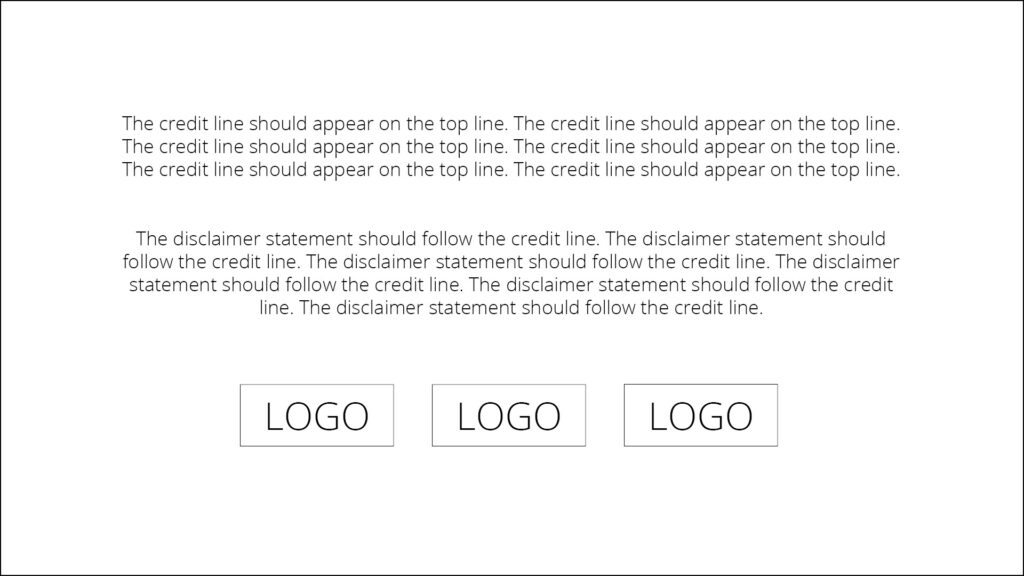
You are required to have the Logos, Credit Line, and Disclaimer in reports and publications. In select cases the logos may be omitted due to space or formatting requirements. If you have questions about how to acknowledge funding on your materials, please reach out early to IAF Communications.
For most reports and publications, a funding acknowledgement page is included near the beginning of a report. This will contain the credit line, disclaimer, and logos.
An event or project announcement is considered a ‘public announcement’ and requires advanced approval. All event material should be submitted together as one approval. This may include an event poster, a registration page, and social media posts.
Announcements such as news releases should be submitted as early as possible. Our funders require additional time to review announcements, especially if you are requesting a quote.
Submitting Materials for Approval
All materials must be approved in advance. It is important to submit materials well in advance of your distribution deadline, as it can take some time to review. We recommend you allow yourself 10 business days for approval, as IAF works with the government funder to ensure acknowledgement is appropriate.
How to Submit Materials Via the IAF Client Portal
To upload a material for review:
- Visit the IAF Client Portal and log into your account.
- Navigate to the Funding Acknowledgement section of your project (on the Project card, select Active).
- Scroll down to the Funding Acknowledgement section, click the ‘green plus’, complete the information, and upload the related document or material.
- When you click SAVE, it will automatically be submitted to the IAF Team to begin the review process.
The status of your request is available in the IAF Client Portal, on the left side near the bottom you will see a Funding Acknowledgement section. The section lists all your request under review, requiring your attention, approval and declined. You will receive an email to your inbox when updates are made.
Learn how to submit material:
Resources
Funding provided by:

Funding for this program has been provided by the Sustainable Canadian Agricultural Partnership, a 3.5-billion, 5-year agreement between the federal, provincial and territorial governments to strengthen the competitiveness, innovation, and resiliency of the agriculture, agri‐food and agri‐based products sector. The program is delivered by the Investment Agriculture Foundation of BC.